Improving maximum strength can steadily make a big difference to an athletes maximum speed , ease of race speed and the ability finish strongly. This needs to be varied throughout the year and culminate in light power development work. I believe in improving strength and power in the gym and leaving the endurance training for the track and circuit work done in sessions at the track. The only endurance work done at the gym is usually mid-torso training.
Low Hurdle Plyos
The aim is to develop
quick contacts with the track. So the hurdles are kept low to allow this to happen. Also this should be done in very low volumes only eg. 10 sets of 3 contacts with double legged bouncing. (High volume plyometrics is from the old eastern bloc drug cheating regimes)
Background Training
Base training usually involves plenty of hills and bounding uphill. This slowly builds up strength endurance.
Changing Pace Practise
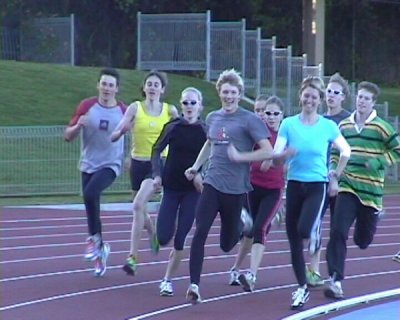
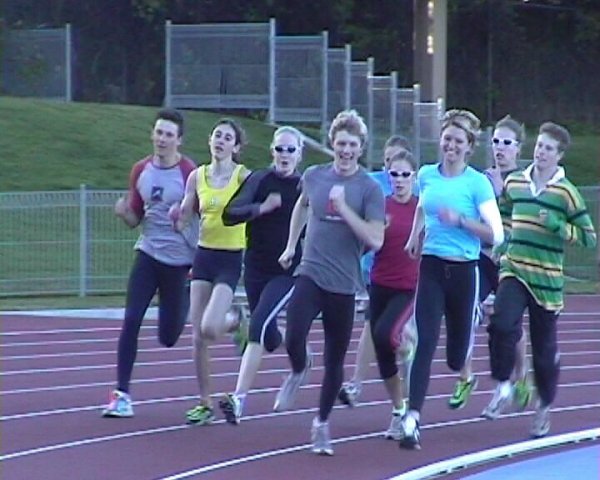
Flyers Group at AIS
Changing pace needs to be practised to be developed. Simulating race pace conditions is great fun for the athletes. Get the athletes to “bounce each other around” and take turns being the first person allowed to change the pace. This is great fun and great preparation for racing.
Author: Steve Bennett The Most Common Training Mistake made with Sprinters – Attempting too much sprinting in a state of neural fatigue. Sprinters commonly attempt too much quality training too often, by this i mean too often in the week, too close to super heavy gym sessions, too many reps in a training session and training reps that are too long. Its also too easy to give sprinters more speed endurance and conditioning work than they need just to make them feel happier about doing something and this also sabotages the quality of their most important activities and that is sprinting at 100% maximum speed. The microcycle (which may be as short as week) needs to be planned carefully with the highest quality most important development activities planned first and then all the conditioning work and extra activities planned carefully around it. Each athlete is different and what they can do and stay balanced with highest quality work actually being enabled will vary throughout the athletes development. Beware of the chronically stale sprinter syndrome where the athlete is always in a state of neural fatigue, evidence of this is apparent if the athlete runs much faster after being sick or injured. Try to maintain and even improve all high quality activities almost constantly through each macrocycle, make every high quality element measurable so you can monitor it. That sets us up for anther topic for another time about the need to split a sprinters development up into 3 macrocycles yearly and in many cases get -2-3 years of improvement in one year and avoid injuries at the same time.
strong>Sprinters need to be steadily throughout the year training for more strength and then training in ways to let their nervous systems learn how to use the extra strength & convert it to power. Its not enough to lift heavy weight or lift weights fast. Muscle contraction are far faster than any lifting that can be done. See every activity as a way to let the brain learn. Just like when you learned to walk.
If you do too much high quality training e.g. heavy lifting, max power lifting, max speed running or max acceleration & your nervous system will be overloaded and your sprinting improvement will go stale. You will learn to run slower.Some squads do this all year, every year! There are probably superstars in those squads that are having their potential destroyed. Just like a talent singer who pushes their vocal chords too hard too often. They will end up with no special talent showing itself.
Some theories say to lift weights & run in the same session. There are a few ways to do this:
Lift specific heavy weight first in small volumes first and then sprint flat out shortly afterward. The best specific weight exercises is single legged step ups on a low box.
Lift weights straight after the sprint session. This creates more recovery for the nervous system for the next quality session.
Mixing some bounding alternate legs is a good way to link strength training to sprinting. (i will write another separate article about this soon)
The main thing not do is volumes of half effort sprinting and think that is sprint training. It is only conditioning & filling in time. Done too fast these will spoil speed development as well, and doing them in volumes will only convert fast twitch fibres too slower.
Just a few sprint training ideas today for runners who want to improve. Think of yourself as athletes like a dragster. To be faster your engine needs more power to get an engine upgrade you need to train smartly with weights for years. This will if done properly look after your engine requirements to the best of your genetics.
At the same time as you do this you need to work on getting your engine to deliver what you want through the tyres. This requires you to give your nervous system the opportunity to practise using the improving engine as often as possible in the most effective way. Put simply, you need to sprint over short distances faster than you ever have before, you need to practise starting quicker than ever before and to jump or bound or do whatever power activity you do better than ever before. Your brain needs practise at accessing and using your newly available power & strength. This is what sprint training is. You are training to give your brain the chance to convert the new engines abilities into improvement in running speed.
Body builders & weight lifters can lift much more than most sprinters, But without sprint training it most likely has no positive effect on their sprinting speed if they dont do sprint training.
Regular small doses of the best quality sprint training is the key to seeing steady improvement in performance.
So the plan is to 1/ Upgrade your engine – by doing smartly planned weight training 2/ Convert the gains by doing Sprint Training – small amounts at 100% effort.
Do your homework by performing a variety of core (back & abdominal) exercises this helps the link between the key power muscles and the running action.
Balance all the different elements of training each week, so the different activities do not spoil the quality of the others. If done properly over the course of your development everything should steadily improve. If it isn’t do something slightly different.
Variety of quality is the KEY.
The biggest mistake for sprinters is to do too much. It is amazing how little you need to do when its done perfectly and doing slightly more than that is BAD. This is why you need a coach and to do what they tell you. Coaches be confident and its better to do less even if the athlete is frustrated at how little they are doing, be firm.
If the athlete is steadily improving you are doing the right thing. So keep it like that.
In our fast paced world it is easy for athletes to get run down many things outside of training itself. Living a balanced life and at the same to reaching your potential in athletics is a challenge.
Many athletes:
need to work full-time or study full-time.
live in Cities without a variety of trails on different surfaces to run.
face many opportunities to socialize at times that challenge the sleep needs of training.
Reaching your potential means producing over a long period of time maximal adaptation. To do so means performing consistent high quality training. We all can relate to days where we have trained badly in the afternoon because of draining activity earlier in the day.
So OK what can we do about it. What follows are just a few ideas.
Sleep
-Have a consistent wake-up time. If you have a late night which should not be very often. The best way to aid recovery is to have a 30min snooze early afternoon and get a slightly earlier night. Researchers have found that sleeping in more than an hour is bad for sleep rhythms and is counterproductive.
You should be aiming for at least 8hrs sleep each night but more ideal would be 9hrs. Joaquim Cruz and Jose Luiz Barbosa whose training plans I have seen had their bed times specified as 10pm bed and 7am rise.
Massage
All athletes should aim for 2-3 massages a week on at least the key areas. Learn how to massage effectively by paying for some professional massages for as long as budget lasts. Then train your own support people to help inh this area.
Diet
All athletes should have their diet studied and optimized. Consuming too small an amount of Carbohydrates is common and can leave an athlete fatigued through muscle fuel depletion.
Recovery Activity
-Go easy on easy runs they are performed to speed up recovery not to add more fatigue.
Swim for recovery – you do not need to swim for fitness just have afloat around.
Physiotherapy
Visit physiotherapists and learn techniques for maintaining muscle looseness from them. A popular area now spreading is the use of acupressure triggers. I find that this is a great way to loosen tight and sore areas.
Scheduling
Make sure you have easy weeks regularly and allow more recovery than the usual.
Live-Work-Training
It makes the most sense to live-work-train as close as possible.Talent can be found in difficult circumstances but I am sure the World Elite have it pretty simple in this way.
Conclusion
Training harder when already tired is of no value. To gain maximum adaptation an athlete needs to train very hard when fresh enough to perform at high quality and then rest really well so that this process can be done again and again. Resting is always a race the quicker you can recover the harder you can train and the closer to your absolute potential you will reach.
Sprinters need to maintain a high level of speed all year. Over the past few years I have found the best way to develop sprinters is with a double periodized year. This is because they can then be training with high levels of speed all year & working on every area of development in a more effective way for a higher percentage of the year. What follows is the outline of a yearly plan:
Yearly Plan – 44 weeks
Conditioning Phase A 8 weeks Every 4th week is a recovery week
Weight training initially targets hypertrophy & general conditioning. It is usually performed 3 times per week. Interestingly when athletes lift in sets of 8-10 they stay much fresher in terms of their nervous system than later in the year when they are lifting more intensely with sets of 3-4. This means that during the conditioning phase it is much easier to perform quality running without it being effected by flatness from the weight training sessions. Late in the phase sets should decrease from maybe 3 sets of 10 to 3 sets of 8. Athletes should lift upward fast & down slow, they should not lift to the same tempo as a body builder even though the aim of this phase is to attain some muscular hypertrophy.
Plyometrics in this phase should aim to develop power with the longer contact varieties. Standing start bounding e.g. 4 alternate leg bounds & a jump into a sandpit can be performed. Standing long jumps & standing triple jumps can also be performed.
Hill training can be performed over distances of 60-100m and some can involve alternate leg bounding. e.g. run 60m bound 20m.
Athletes should perform two relaxed tempo sessions on grass per week & total between 1200m-2200m in each session. It is essential to keep tempo sessions slow so that they do not effect the quality of training the next day. This means running 100m reps not within 4s of maximum effort. A good tempo session may be something like 4 sets of 6 x 60m with a set of pushups & crunches before each rep. Athletes can rest after each run for 30-60s then start the exercises & have 5min between sets. These sessions build good general conditioning & are a much better alternative for sprinters than jogging for 20min.
Speed development sessions initially focus on improving performance over 30m from a 3 point start. Often what happens is the athletes will find that improvements in strength, bounding & 30m times will happen concurrently throughout the phase.
Strength Phase A 6 weeks
During this phase weight training changes to smaller sets e.g. 3-5 sets of 3-6 reps to target the development of maximum strength. This move can easily negatively effect the quality of running that can be performed the next day. It is ideal to be able to do fast track sessions in the morning & then weight training straight afterward or later on in the same day. In this way it is easier to balance the recovery in the week to maintain quality in faster track sessions. Weights should be continued 3 times a week.
Maximum speed work should expanded to include as well as the 30m runs longer distances of 40m, 50m & 60m. It is best to shift emphasis to 40m then to 50m then to 60m. In the second period the emphasis can start longer & be built up to include some 80m sprints. It is also a good idea to do some flying start runs of 15m to 30m or in & outs over longer distances. Speed sessions can be performed twice a week. It is important to aim to do only as many sprints as you can perform with quality at maximum effort. Make sure the athlete can back up from the session to the next one & still perform good quality. If the athlete is finding that they can’t back up for the next session do less reps , do the runs sub-maximally or do less weights. Balancing this area is a key problem when coaching sprinters.
Plyometrics should progress toward varieties that have shorter duration ground contacts. A good way to do this is by performing running start bounding. e.g. 10m running start then 4 alternate leg bounds & a jump into a pit. They should continue to do longer contact bounding as well. Plyometrics should be done once a week.
Hill training can be continued by decreased to once every 2 weeks. The hill session should be of less volume of shorter hills with some bounding e.g. 2 x 3 x 40m hills with run 20m then bound 20m these can be done like a tempo session with exercises in between sets. It is also a good idea at this stage to start getting used to some speed endurance on the track by doing just 2 fast relaxed 150m reps on the track after the hill session. This will make it easier to transition to more work on the flat in the next phase.
Athletes should continue performing two simple tempo sessions on grass per week & total between 1200m-2200m in each session.
Power Phase A 4 weeks
Weight Training 2-3 times a week moves toward a power focus. A small volume of strength lifts are maintained. One gym session a week is aimed at developing power with exercises such as:
stiff legged bounces with a light weight e.g. 20kg
jump up onto a box with less than 30% of 1RM half squat.
stomping step ups with less than 30% of 1RM half squat.
power cleans These are often done in a circuit type situation with some heavy ¼ squats includes for a contrast effect. Plyometrics should progress toward even quicker ground contacts. This is done with the performance of alternate leg speed bounding. These are done with a 10m running start and the aim is to get as much power into the track as quickly as possible e.g. taking the minimum number of strides to go 30m but also in a minimum time. The athlete needs to aim to strike the ground well underneath the body. Hill training is replaced with small volume speed endurance sessions e.g. 150m rest 8min 150min rest 8min 150m rest 2min 150m. Maximum speed sessions should be expanded to include sprints of up to 60m. They can also start to include some over-speed either using a strong tailwind or an assistance system. These should be performed in small volumes that the athlete is used to using. Athletes should continue performing two simple tempo sessions on grass per week & total between 1200m-2200m in each session.
Competition Phase A 3 weeks
Weight training sessions can be performed once a week with a very small amount of a complex lifts just to maintain strength e.g. power cleans as well as ¼ squats are performed to maintain strength. Plyometrics are stopped to enhance the athlete’s nervous system freshness. Maximum speed sessions are performed of the same variety as the power phase but the emphasis needs to be on racing. The 72hrs leading into the race need to be free of anything that could effect the nervous system on the day of the race. This means almost no intense high cadence training, plyometrics or heavy lifting. Tempo sessions once to twice a week with 800m-1600m in each. Competition.
Conditioning Phase B 6 weeks
Similar to Conditioning A but the athlete should be entering this phase with higher levels of speed. They should do the smaller volume hill session from the strength phase e.g. e.g. 2 x 3 x 40m hills with run 20m then bound 20m with full recoveries and exercises between sets. Maximum Speed Development can be of a greater variety between distances of 20m & 60m. But most work should stay at 40m. Plyometrics should be of the long contact variety and can be combined in a session with block starts. Some alactic capacity speed sessions should be performed involving the use of larger numbers of short repetitions e.g. 3 x 4 x 60m at less than 95% effort with 2min between reps and 10min between sets.
Strength Phase B 6 weeks
Similar to Strength A. The athlete should aim to become even stronger in this phase. Hills should be replaced in this phase with speed endurance sessions that are initially longer repetitions e.g. 2 x 300m but progress toward shorter repetitions of 100-150m. Maximum speed development should stay the same as in Conditioning B. Plyometrics should progress toward quicker contacts. Some alactic capacity speed sessions should be performed involving the use of larger numbers of short repetitions e.g. 3 x 4 x 60m at less than 95% effort with 2min between reps and 10min between sets.
Power Phase B 8 weeks
Similar to Power A Plyometrics is speed bounds & some higher intensity plyometrics in low volumes e.g. over hurdle bounces e.g. in my squad an athlete did 6 x 2 plyo-hurdles at heights up to 107cm. Maximum speed work should increase in distance & could re-introduce over-speed. It is important to do block starts & reaction time practice during this period. Speed Endurance should focus on progressively shorter repetitions down to sessions like 2 sets of 2-3 sets of flying start 60m-80m runs with rests between of 3min and 20min between sets. Some competition but not so frequent that the training plan is disrupted.
Competition Phase B 8 weeks
Mental & physical freshness for races is the highest priority. Gym once a week should focus on maintenance of strength with a small range of complex lifts. Speed sessions should focus on technical aspects or extra speed may be chased using over-speed methods but this is not a good time of year to sustain an injury. Speed Endurance should be enhanced from appropriate amounts of racing. Tempo sessions of 800m-1600m should be continued once to twice a week.
Recovery Phase up to 8 weeks
Summary
The aim is to perform the following simultaneously as the competition phase approaches during each half of the year:
decreasing contact times of plyometric activities.
decreasing total volume of weights & aim finally for improvement in power.
extending the distance of sprints from blocks.
decreasing the distance of speed endurance.
decreasing the volume of relaxed tempo sessions.
decreasing total volume of all training for major races
introducing some over-speed when appropriate late in the preparation.
build confidence & mentally preparedness for racing with block starts, reaction drills etc.
Sprint Training for the Developing Athlete. by Steve Bennett B.Sc. (Physiology)
This article is designed for younger athletes who have done little training. It contains the main points of a long term approach.
It is initially much more important to improve balance, posture and stability of the trunk than it is to improve leg or arm strength.
Sprinters should develop overall fitness in a way that does not involve jogging. They should however BE ABLE to jog for a long distance without a problem. Overall fitness can be acquired through dance, medicine balls, skipping etc. A variety is best. Progressive circuit training is great.
Improving the ability to have the type of speed that comes with little effort is the goal. Athletes need to always practise relaxing when running. The is a skill that must be practised from a young age. RACING can often be a time of practising the bad habit of trying too hard especially in the very young. The ability to run fast and have it look easy is of the highest importance. The quality of an athlete that can have very fast steps is the first thing that needs to be developed from a young age.
Sprinters should not be instructed to run on their toes or to pump their arms high. -It is better to develop a foot that is moving backward before impact and a foot carriage that is as close as possible to the shin (Dorsiflexion). -Arms should be held with relaxed fingers and the main focus of effort should be a backward stroke. They should also not move very far forward from the body.
Maximum running speed is the most important quality to develop on a regular basis. This should be done with maximum speed experiences over short distances. eg Flying start 20-30m runs or Standing start runs over 30-40-50 or 60m. The athlete should perform these runs at maximum relaxed speed in sets of 3 with rests between of 3-5min where they stay active and between sets they should do other balance or trunk activities for maybe 10-15min. eg A maximum amount may be 3 sets of 3 runs over 60m. A good amount to do regularly (ie. 2-3 times/week) would be 2 sets of 3 runs over 40-50m. The athlete should never do more once they are getting slower within the session eg. If the times over 60m are 8.30, 8.20. 8.25, 8.30,8.60,8.80,9.00. Then they should have ended the session after the first obviosly slower run in the session and in the example that was the 8.60. Initially runners may be slowing after even the first run, but with training they may be able to 9 runs at the same speed.
The ability to develop the endurance to finish off a 100m or 200m race is best developed in races. Training at slower speeds to improve performance in these events is mostly of a little positive effect. Endurance is best developed while running at race speed If the athlete is really lacking in Speed Endurance at the end of these races they could do sessions like below:
2x 3 x Flying start 60m runs at high speed with rests of only 90s
4 x Flying100m very fast rests 3min.
The 400m event needs special training at the slower 400m race speed. The ability to relax and use little energy is important at race pace. Some sessions to improve performance in the 400m are:
10 x Flying 100m at 400m race pace rests 3min
4 x 200m at 400m pace rests 5min
2 x 300 at 400m race pace rest 15min
400m athletes should also do more endurance training and can get by with more jogging especially in the off season. Maximum speed training is also of high importance.
It is important to have good foot function and for this reason it is useful for athletes to spend as much time as possible barefoot. Walking on sand is very good. Training should be conducted in very light simple shoes. Racing flats from the Runners Shop are much better than joggers for training in.
In Cold weather athletes must warm-up carefully and keep warm. Tights are great for training in as they maintain warmth during the frequent recoveries.
Training to improve muscle elasticity is very useful in all athletes eg. Games like Fly, Hop-Scotch, Skipping short distances, Leap frog and playful hopping and bouncing around are all great stimulation to the elastic qualities of muscle. Combining sensible amounts of these activities with balance challenging activites and relaxed movement practise would be ideal especially for very young athletes.
Any strength training should be restricted to the trunk until the athlete has optimal development of their posture and good levels of stability. Strength training is much more effective after this is developed anyway.
Young athletes lose flexibility as they grow and their bodies will naturally try to cheat to find ways to move to make up for the deficiency. Small amounts of perfect practise are better at decreasing the development of bad habits. Large amounts of high effort training during stages of decreased flexibillity and poor posture will result in the athlete learning a bad running style that will be more difficult to correct. Athletes need to have a smart stretching program designed persoannly for them during periods after faster growth. They need to be taught good posture and given feedback on what is good and bad posture when sitting, standing, walking and running. Most of our society have posture far below ideal.
For many years now debate has raged between advocates of the two extremes of training for middle distances. We have had athletes who have been on well over 160km a week running great times in 1500m and also some running very fast off a much smaller volume of in some cases less than 100km a week.
Both extremes of training can work for an athlete. What the high volume athlete lacks in intensity can be ‘made up’ from the benefits of the slow stimulus of volumes of aerobic running. What the lower volume athlete lacks in volume can be ‘made up’ for with extra intensity. There are trade-offs and risks of both extremes however and this is essential when working out what is best for a given athlete.
The high volume athlete runs the risk of overuse injuries and this is especially so if the training includes a high percentage on the roads. They also run the risk of lowering running efficiency at race pace if good form work is not done to compensate for the potentially damaging effects of running slower most of the time. The athlete can lose speed & ease of speed. Some would argue though that increased mitochondrial density and capillarization brought about in a more extreme fashion by high volume training will in fact improve efficiency – as will the extra muscular conditioning of the lower legs from running slowly with a minimal knee lift.
The low volume athlete because of the higher intensity will face a much higher risk of overtraining & burnout both mentally and physically. I know of athletes whose immune system has let them down and they became repeatedly sick because of the steady regime of highly anaerobic work they were doing for most of each year. I believe athletes don’t last long like this, they have short careers. This may be especially true for female athletes.
Many of the best athletes in the World that lasted for the longest were in fact higher volume athletes like John Walker.
I believe the answer to the debate is to do both, periodize (plan) the year smartly, build to high volumes in the offseason on softer varied surfaces, be cautious with highly lactic speedwork save it for the pre-comp period. Let athletes aim for goals that are within the next 3 months XC races etc. But in base building periods train at intensities that are certainly well within the coping capacities of the athlete. Do good running form – “ease of speed” development sessions most of the year but keep the volumes and intensities at a level that fits with the volume the athletes are doing. By intensity I mean lactic intensity eg 4 x 150m at high speed is not near as intense as 4 x 200m at the same speed. The extra 50m puts the athlete into the lactic zone much more just like 4 x 300m at same speed would be much more intense again. Speed can be developed and maintained safely in terms of musculoskeletal injuries from sessions of faster shorter reps with a total session volume of reps of less than 1000m eg 4-6 x 150m at a good speed with plenty of rest (2min+)and 8min between sets if needed. This is a very effective ease of speed development and form workout that is not that intense (especially if rests are longer like in excess of 5min).
There is a common tendency for endurance squads to focus almost exclusively on interval training with short rests between reps. The forgotten diamond is when building toward peak season to do interval sessions with much longer rests at very high intensity. Examples are: 3 x 400m rest 8min at faster then 1st lap of an 800m race pace. 5 x 300m rest 5min at faster than 1st lap 800m race pace. 800-600-400 with 12min active rest at 1500m race pace and better. 4 x 200m rest 5min at 400m race pace The above sessions are the missing ingredients in many programs. The only way they could be anywhere near replaced is with racing itself. I once saw a 1:47 800m athlete do 3 x flying start 400m runs in mid47s with only 8min rest in between. This was a much tougher ordeal physiologically than an 800m race.
With sessions like 4 x 2000m rest 3min there are many ways to run it. They can be run at 5000m pace or faster i.e as hard as the athlete possibly can. They could also be done at 10000m race pace which is a bit above the Anaerobic threshold pace. The 10km pace version is much more sustainable over many months of base training and can easily be preceded by a long warmup and a long warm-down. The faster “eyeballs out” approach to the session is certainly not something that an athlete can sustain for many months even though gains in Vo2max may be high. Training is all about having optimal adaptation, not just quick adaptation. Sometimes slow adaptations from many areas can add up to elite performances because the athlete can be sitting at a level where just 2 months of comp prep intense training combined with racing can lift them to a super high level FROM what was a pretty low-intensity regime of significant volume. BUT they need those ease of speed sessions to be comfortable running fast again.
I believe now that especially with female athletes transitioning from juniors to seniors we need to increase the volume & be cautious with the intensity but continue the speed development. Most will last better as long as their bodies suit it on 80-100km a week of steady running than 40-60km of hard fast running.
It is essential that athletes all do both a volume that their biomechanical structures can handle and the intensity that their physiology can cope with. Eventually, their ability to maximally adapt to both at the right time is the key to optimal performances in MD events.
Loving their training & variety of stimulus is the key. Putting enough solid work in that the effects over a longer period of terms unveil unexpected improvements in performance when the time is right.
Having a large group of training pals and doing sessions they can do together without racing all the time is key to long term longevity for senior athletes and also those transitioning from late school years to jobs/uni etc.
Speed from Strength By Steve Bennett B.Sc. (Physiology) www.oztrack.com A great thing for any runner to develop would be more “bounciness” and in any endurance athlete would be “sustained bounciness”. The good news is most athletes can improve the power and also the sustainable power of their stride by a large amount.
Sprinters can improve their stride frequency by improving technically in a number of ways. They also need to have optimized their power delivery by having high levels of stabilization strength and developed powerful prime movers. For many people running fast can be developed very simply. They just need to develop strength in the gym and prac
tise fast running that creates the opportunity for the nervous system to better learn how to utilize the gains in strength. Middle Distance athletes have a need to develop high levels of endurance so they can sustain race pace for the distance required e.g. 55s laps for 1500m. To win these athletes will also need to be able to change pace rapidly and have a sustained higher speed finishing burst. In Australia we had Said Aouita appointed as our National Distance Coach in 2002. The key area of his philosophy is for athletes to do enough quality volume in key sessions to develop high levels of stamina. He also believes in building very good recovery into a program by having plenty of recovery days and weeks. Said believes in the following ideas: • Speed for Middle Distance athletes can be developed from the effects of weights, many repeats of short hill repetitions and plyometrics. Importantly this can be done without the athlete doing volumes of really fast sprinting, which for middle distance athletes is a common cause of injury. • Plyometrics is even more important than weight training in developing the type of speed that Middle Distance athletes need. • The key to developing athletes who can be safe training with plyometrics is to have young athletes doing a variety of lower intensity plyometric activities. As adults these athletes will be much more able to fully implement training in this area to great effect with safety. Older athletes need to build intensity slowly in this area. In the past my squad has performed a wide variety of plyometrics. The activities described below have been enjoyed by the squad and have not caused any injuries, even with young athletes. A summary of some of the activities from our plyometric program follows: Hill Bounding Hill bounding is very effective at improving hip extension power and can have a great impact on all runners regardless of their event. Hill bounding stimulates the athletes to be able to generate more power which is sustainable and is also good conditioning for other more intense power activities. All bounding involves the athletes impacting with a flat foot and having an active foot strike (the foot is moving backward as it hits). Athletes need to stay tall, lift their knees high and in long bounding aim for some “hang time”. Each foot contact needs to add to momentum, it is common to see athletes reaching in front for more distance which causes them to lose more momentum. The key is to have the athlete use high levels of hip extension power generated by the glutes to project the body forward. When bounding up hill it is best to make sure the athletes foot on impact is pointing straight up the hill and the knees should be lifted up high in front while the athlete stays very tall. The sprinters in my group in the early phases of periodization did 2 sets of 5 x 60m hills where they run 20m – bound 20m – run 20m. They have often progressed to 2 x 5 x 60m hills where they bound 20m – run 20m – bound 20m. They do these with 2min between reps and 5-10min between sets. The Middle Distance athletes have built up to do more of them and we have found good effects from 20 x 60m hills with 20m bound – 20m run – 20m bound with a walk down rest. They do the bounding less powerfully than the sprinters and do more of them quite safely. The activity is low stress on the athletes structurally but they can certainly feel it the next day by having sore glutes, this is evidence of some good work being done. With the MD athletes we also sometimes do hill circuits where the athletes bound up a 50m hill run across the top and then swiftly down a gentle slope across to the bottom and then back up the 50m bounding section. The circuit has been about 600m a lap and they have built up to doing 6 laps. Bounding We perform three types of bounding. All three kinds we have had great success with while using very low volumes. Standing start bounding performed about once per week for much of the year. 5 repeats of 4 bounds and a jump into a sandpit. Measure the total distance of each effort and strive for progress. Improvements in mid-torso strength and leg strengthening from weights (especially the glutes) should assist progress. Rest between at least 3 min. I have athletes do these in racing flats on a mondo surface. Most athletes can improve the total distance by over a metre in a season. Running start bounding Running start bounding is performed more with sprinters/jumpers. It requires the athlete to be technically good at standing start bounding. The athletes need to get off the ground much quicker after each contact during this type of bounding and because of this it is much more specific to sprinting. The athletes in my squad have often performed 5 repeats of 4 bounds and a jump into a sandpit from a 10m running start. Once again the total distance is measured and the athletes aim to progress. Athletes may need to start with a 5m running start. High level athletes can progress to doing them with a 8 stride run-up and then 9 bounds and a jump into the pit. Middle Distance athletes do running start bounding in the pre-competition phase as well. Speed Bounding This is the most specific form of bounding a sprinter can perform. We usually do speed bounding from a running start over 20m or 30m. We time the athlete over the distance and also count the number of steps. By multiplying the time in seconds by the number of strides the “Speed Bound Index” can be calculated. The lower the index the better the athlete. Once again we only do about 5 attempts over 20-30m and have seen great athlete progress. There are many more intense activities that will be covered in a future article, but the ones listed above are simple and effective when used by any running athlete.
There are many very young (9-13yrs old) extremely talented athletes out there. Some of them like Australia’s Georgie Clarke can make great progress at an early age. 800m age 11 2:12 age 12 2:08 age 13 2:05 age 14 2:02 ….age 16 2000 Olympics Semi-Final in the 1500m . In the early years, she was on a very minimal and varied program and still performed brilliantly.
You only have to watch any young Athletics Championships. Some of them are showing talent because they are simply early maturers or they have already done plenty of specific training. BUT there are some that are showing the necessary qualities required to really do something great on the track as mature senior athletes and have done very little specific training. The question is what do we do with this latter group of super talented athletes? The answer to this question is often full of distractions most of them seeded in jealousy and rivalry. eg. Accusations of athletes being trained too hard are common. Even when the athlete is doing a good variety in training.
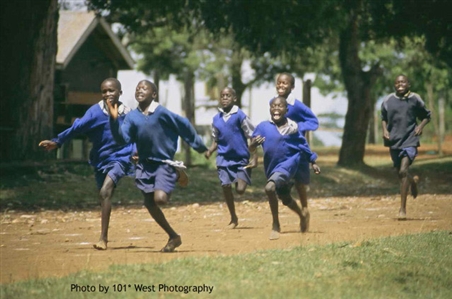
We have to recognize that many other sports start their preparation much younger than Athletics. If we want athletes with good qualities as adults our young athletes need good long-term preparation. Sitting down all day watching TV or at school, wearing shoes all day, only exercising in competition and not having a variety of experiences of the positive effects of exercise are just some of the obstacles we face. In African Nations, the children do a lot of variety of activities as part of their lifestyle that gives them strength and conditioning. If we want our athletes in any sport to have a chance we have to provide them with variety when they are young or we will have to play catch up later to keep our athletes healthy.
These super potential young athletes need a broad base of training stimuli. They need coaches that are willing to arrange it for them. Not Coaches that will focus ONLY on the areas that give good results fast. Adrian Faccioni and Di Barnes presented some great information at the 2001 Australian Track & Field Coaches Congress. http://www.faccioni.com/lectures/juniorcondition.PDF Athletes at this stage of development should have great variety in their programs. What follows are some examples and ideas:
Swiss Ball – training sessions – great for mid-torso development and balance.eg 20min session maybe 1-2 a week, follow videos or do a class.
Pilates – do a floor class or follow a video – similar to above. Maybe even integrate some of these exercises into a warmup phase of a session. -maybe 1 a week
Gym – Train with free weights only and avoid max weight lifts. It is important for young athletes to develop strength. However, good guidance and supervision is needed. Variety in the program is needed. Start with small duration sessions – maybe just 1 a week.
Steady Running – run on grass, dirt and mixed uneven terrain at varying speeds, make it fun. Kenyan athletes who are in their thirties in many cases are athletes that were playing on their farms (strength training) and play running 100+ km a week to get to school on uneven terrain from age 6. The trick is NOT to structure it and have young athletes pound out the steady continuous runs at an even pace on even terrain (road) or on a track!!. If we got Kenyan youngsters to do this they would not last long either. There is no reason why our young athletes cannot do regular play like runs of 30min on un-even surfaces combined with walking or long all day bushwalks etc. Make it as natural as possible – search out trails and stay off paths and roads.
Bushwalks – are a great way to build base stamina and strengthen legs. A very natural exercise mode. There are some great ones in any National Park.
Other Sports – Participation in a variety of other sports is good for all-round development both physically and psychologically. We just need to make sure that in whatever other sport they play that the training and competition should be very varied and appropriate. Many other sports are years behind athletics in using methods that are the best in training for running.
Athletes that prepare for Athletics following the general philosophy presented here will be prepared brilliantly for other sports that they may play or later specialize in.
Medicine Ball – med ball exercises can be performed that are good for everything from balance, strength, power etc. Maybe even help our athletes not get knocked over as easily.
Be creative.
Foot/ankle/lower leg conditioning – walking on toes, walking on heels, walk on soft sand, foot strengthening eg roll up a towel, pickup pencils etc.
Plyometrics – bouncing exercises of varied intensity in different directions. Maybe over obstacles or up onto obstacles. Do standing Long Jump tests. Play hopscotch. Ease into it gently and design other fun games to play. Whatever athletes are regularly doing will generally not be a problem.
Competition – DO NOT over compete. Young athletes should enjoy the process of all aspects of this sport. It is common to see underprepared athletes (that are supposedly being looked after) over competing by going in multiple races a few times a week. Athletes cannot work on technique when under pressure. Competing a lot may be fun but is the quickest way to create future problems. When athletes do compete in a variety of settings against athletes of varied ages and levels, and in different events. Spending all day at track meets or Gala days is not everyone’s idea of fun so try to spend quality time at the track. Not hours waiting for the next event.
Speed improvement – this is an important age for the development of speed. To not work on it now may mean missing the boat. Increasing cadence and improving coordination is very important.
Technical improvement- This is paramount to longevity. Young athletes must spend enough time each week improving their technique. The common way to compromize this development is to compete too much (no athlete will be able to change an old technique during max effort situations) or do too much of one type of training eg focusing only on aerobic development.
There are many talented athletes that fail to make it or develop chronic injuries that prevent them from reaching their full potential. I believe that with these athletes we can maximize their chances of avoiding problems by providing them with a varied program and ALWAYS focusing on improving technically and being patient. Never let one type of training dominate the others. When the athletes are mature then it may be more appropriate to let certain kinds of training dominate the program ESPECIALLY if as a young athlete they were exposed to a few years of multilateral training and now have excellent posture/technique etc. In the meantime athletes that train with variety will likely meet success off relatively small volumes of training in every area and show good performance improvements anyway. The best way to judge a program is that the athlete should improve steadily technically. There may be hiccups as the athlete has a growth spurt for example BUT generally, the athlete should be improving technically throughout their foundation years.
“Saving kids for later” by getting them to do next to nothing in a low key program is a myth that will never produce talented athletes that are resilient as adults.