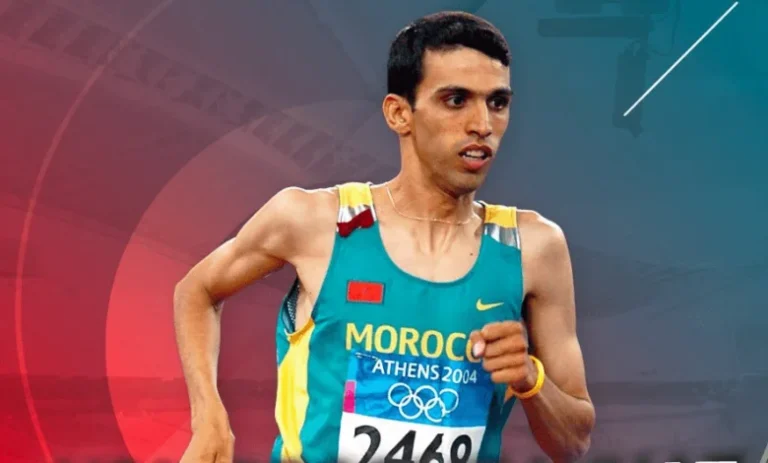
Hicham El Guerrouj training for the 1997 season.
On April 1994 I was in charge of the Mexican
women's team that participated in the 2nd IAAF/ World
Road Relay Championships held at the beautiful town of Litochoro,
Greece. Upon arrival at Tessaloniki airport we got on the same
bus with the Morocco mens team, the team manager then was Said
Aouita, among other things he told me was that they were going
to win the race and talked a lot about a young skinny and shy
athlete named Hicham El Guerrouj. He said that this young man
was going to become the best 1500 runner in history. I thought
he was exaggerating a little. Two days later the Moroccan team
beat Ethiopia (W. Bikila, F. Bayesa and H. Gebresilasie included)
and Kenya. El Guerrouj covered the 3rd stage (5000m)
in 13:43. Later, during the track season he appeared at world
scene with a1500 mark of 3:33.61 at 19 years of age.
Hicham el Guerrouj was born on September 14,
1974 (1.78m/58 kg) in Berkane, a city located at sea level.
He began to practice athletics in 1990 and in 1991 was chosen
to train at the National Institute of Athletics in Rabat, joining
from the beginning to coach Abdelkader Kada group. He
made his debut at international level as member of the Moroccan
Junior team for the 1992 World Cross Country Champs finishing
14th, in Junior race and later he got 3rd
in 5000m (13:46.79) at the IV World Junior Champs in Seoul 1992.Taking
part in cross country races is normal within the Moroccan training
system, Said Aouita followed that path during his early days.
Hicham El Guerrouj s later successes are well documented and
known.
Training.
His characteristics are of a very disciplined
and dedicated athlete, not in the sense of going early to bed
or "don't do this", he is very professional in his
job and always is focused in his training. When it is time to
compete he respects and takes into account the tactical instructions
in which he gives his opinion also. He's strong-willed, ambitious,
and believes he can run the 1500 m under 3:24 [Note: when this
was said in 1997 N. Morceli still had the 1500m WR].
Concrete examples are presented next of El
Guerrouj's different training cycles. It can be observed that
he does NOT work large volumes, but there is a predominant
high level of quality. Besides he does not work too much
on the track during the year.
He started to train in middle October 1996,
the training means are shown in the next table and the details
are explained below:
First preparation cycle (from October 18 to
November 7, 1996)
|
Day
|
Morning
|
Afternoon
|
|
18
|
Aerobic endurance
|
strength work
|
|
19
|
Aerobic endurance
|
Physical preparation
|
|
20
|
Aerobic endurance
|
Aerobic endurance
|
|
21
|
rest
|
strength work
|
|
22
|
Power
|
Aerobic endurance
|
|
23
|
Aerobic endurance
|
Physical preparation
|
|
24
|
Aerobic endurance
|
strength work
|
|
25
|
Rest
|
Aerobic endurance
|
|
26
|
Aerobic endurance
|
Power
|
|
27
|
Aerobic endurance
|
Aerobic endurance
|
|
28
|
Aerobic endurance
|
strength work
|
|
29
|
Rest
|
Rest
|
|
30
|
Aerobic endurance
|
Aerobic endurance
|
|
31
|
Aerobic endurance
|
Power
|
|
1
|
Aerobic endurance
|
strength work
|
|
2
|
Rest
|
Aerobic endurance
|
|
3
|
Aerobic endurance
|
Aerobic endurance
|
|
4
|
Aerobic endurance
|
strength work
|
|
5
|
Aerobic endurance
|
Aerobic endurance
|
|
6
|
Rest
|
Rest
|
|
7
|
Aerobic endurance
|
strength work
|
Aerobic endurance.
He does four types of work:
30-45 min of continuous running
50-60 min of continuous running.
For this type of work there are not precise
conditions, he is not asked any specific pace, however. he is
demanded that he runs at his maximum at that moment, this varies
from one day to another and has nothing to do with the season.
So, this means that El Guerrouj can run one day between 3:00-3:10/km
pace and sometimes at 2:50/km.
4 x 2000 m in 5:10 with 2 min recovery
6 x 1000 m in 2:30 with 2 min recovery
The distances of the repetitions have been
standardized because his coach considers important to set a
"work rhythm" with high intensity (around 70% for
him). For this reason, when El Guerrouj can not finish a certain
training session, he repeats the workout the following day,
instead of seeking a different solution.
Strength work.
He works on the main muscle groups, but the
coach believes in work the small ones as well, those that have
major influence in the posture, in a varied way, through the
utilization of free weights and special gym apparatus. During
this stage he has done the following exercises:
Half-squat 6 x 20 reps with 25 kg bar
Half-squat 4 x 16 reps with 30 kg bar
Squat 4 x 16 reps with 20 kg bar
In machines/apparatus:
Hamstrings 4 x 16 reps
Quadriceps 4 x 16 reps
Abductors 4 x 16 reps
Adductors 4 x 16 reps
Lunges 4 x 20 reps with 25 kg bar
Step-up 1 x 20 reps with 30 kg bar with each
leg
Abdominal 300-400 reps
Back 300-400 reps
Power.
He does once a week up-hills 10 x 300 m
besides horizontal jumps and vertical jumps
over hurdles.
Physical preparation.
This type of work includes general exercises,
drills, stretching and back and abdominal exercises. The stretching
exercises are always present in all training sessions during
the warm-up and the end of session.
After this first cycle he competed in some
indoor races, which resulted in 2 world records:
1500 m 3:31.18 WR indoor Stuttgart, Germany,
February 2, 1997.
1Mile 3:48.45 WR indoor Gent, Belgium, February
12, 1997.
1500m..1st_3:35.31 World Indoor
Champs, Paris, March 8, 1997.
Second preparation cycle (March 30 to April
19, 1997)
This cycle started after the World Indoor Champs.
During this stage high intensity parameters are added.
|
Day
|
Morning
|
Afternoon
|
|
March 30, 1997
|
Aerobic endurance
|
Strength work
|
|
31
|
Rest
|
Race Pace
|
|
April 1st, 1997
|
Aerobic endurance
|
Aerobic endurance
|
|
2
|
Aerobic endurance
|
Power
|
|
3
|
Aerobic endurance
|
Race Pace
|
|
4
|
Aerobic endurance
|
Rest
|
|
5
|
Aerobic endurance
|
Power
|
|
6
|
Aerobic endurance
|
Race pace
|
|
7
|
Aerobic endurance
|
Aerobic endurance
|
|
8
|
Aerobic endurance
|
Power
|
|
9
|
Aerobic endurance
|
Aerobic endurance
|
|
10
|
Rest
|
Aerobic endurance
|
|
11
|
Aerobic endurance
|
Race pace
|
|
12
|
Aerobic endurance
|
Rest
|
|
13
|
Aerobic endurance
|
Strength work
|
|
14
|
Aerobic endurance
|
Aerobic endurance
|
|
15
|
Aerobic endurance
|
Aerobic endurance
|
|
16
|
Aerobic endurance
|
Power
|
|
17
|
Aerobic endurance
|
Rest
|
|
18
|
Aerobic endurance
|
Aerobic endurance
|
|
19
|
Aerobic endurance
|
Race pace
|
Aerobic endurance.
30-45 min of continuous running at 2:50-3:00
or 3:10/km
30 min of continuous running as recovery.
Race Pace
Fartlek: 6-5-4-3-2-min fast running.
Track session: 1 x 1600 - 1200 - 800 - 600
- 400 m with short recovery starting with 1 min going down
to 30 seconds!
Power
200-300 Multi-jumps.
Up-hill reps: 10 x 300m with jog back recovery.
Up-hill reps: 5 x 150 m
(Extra comment: He works with plyometric
training doing jumps over low hurdles and several types of
multijumps over grass, "about 300" but that is not an exact
figure, but the main work is done the gym for leg development,
with half squats, quadriceps, isquios with machines, the abdominal
and back exercises they do them almost everyday several reps
with medicine balls.)
Strength work
The work is very similar to the previous cycle.
The only difference is that the coach sets the total duration
of the session:1h 30 min, but El Guerrouj chooses the exercises,
using free weights and machines.
Third preparation cycle, May 11 - 31, 1997
|
Day
|
Morning
|
Afternoon
|
|
11
|
Aerobic endurance
|
Aerobic endurance
|
|
12
|
"warming-up"
|
speed work
|
|
13
|
Aerobic endurance
|
Aerobic endurance
|
|
14
|
"warming-up"
|
Race pace
|
|
15
|
Aerobic endurance
|
Aerobic endurance
|
|
16
|
"warming-up"
|
speed work
|
|
17
|
"warming-up"
|
Rest
|
|
18
|
"warming-up"
|
Race pace
|
|
19
|
Aerobic endurance
|
Aerobic endurance
|
|
20
|
"warming-up"
|
speed work
|
|
21
|
Aerobic endurance
|
Aerobic endurance
|
|
22
|
"warming-up"
|
Race pace
|
|
23
|
Aerobic endurance
|
Aerobic endurance
|
|
24
|
Rest
|
Rest
|
|
25
|
"warming-up"
|
speed work
|
|
26
|
Aerobic endurance
|
Aerobic endurance
|
|
27
|
"warming-up"
|
Aerobic endurance
|
|
28
|
Aerobic endurance
|
Race pace
|
|
29
|
Aerobic endurance
|
Aerobic endurance
|
|
30
|
"warming-up"
|
"warming-up"
|
|
31
|
Rest
|
Adrian Paulen M.
1st_ 1500m 3:29.51
|
Aerobic endurance.
30 min of continuous running at 3:00-3:10/km
40 min of continuous running as recovery.
"Warming-up" (the original word is
"échauffement").
Consists of 30 min easy running and 30 min
of several general exercises. The aim is to get an active rest.
Race Pace
10 x 400m between 53-54 seconds with only 30
seconds recovery. He gets help from a "rabbit" the
last 200 m in each repetition.
Speed work
10 x 300 m in 35-36 seconds with surges and
help from a "rabbit".
6 x 500 m with surges and help from a "rabbit"
the first 300 m in each repetition.
From this moment the help from the "rabbit"
becomes very important, because he is approaching to the competitive
period. He likes this type of sessions, they make him feel like
in a race: with unexpected changes of pace, he improves his
reaction every time that the "rabbit" accelerates.
Results 1997 season.
He had an almost unbeaten season with the Athens
World title in 1500 m_3:35.83. Among his best results were the
3:28.91 in Zürich (August 13, 1997) and Brussels (August
22, 1997) 3:28.92.
Progression at 1500 m
1994 3:33.61
1995 3:31.16
1996 3:29.05
1997 3:28.91
1998 3:26.00
Another PR
800m 1:47.18 (95) ; 1000m 2 :16.85 (95)
Some notes about:
Altitude training.
He trains several times a year at Ifrane,1650m
altitude, at least 3 weeks in each period, although his coach
does not consider an indispensable way of training, he always
seeks for quality no matter the altitude. They don't believe
in going to higher altitudes like Font Romeu (1800m) and Mexico
City (2240m) although have been in these places in the past.
Ifrane.
According to British distance athlete Jon
Wild who spent 3 weeks training in 1998 "Ifrane is
a holiday town for Moroccans. It is quite lively in the summer
with festivals and fairs. A very small place of 1500 (without
tourists) and seems to attract people from all over. Gabriella
Zabo was there in 1998, Julius Achon (Uganda) and the Qatar
national team have been training there as well. There are several
training places like
The Forest. This is a huge area 5 min
jog from the downtown through the streets and up a very steep
hill into the trees. The paths are of light fine sand and not
too soft or too hard but rocky in places. There are many loops
to run one called the "Skah loop".
The "Lake". It is in fact
an old dry lake bed it seems, across a larger grassy area one
can find this flat bed with a path beaten around it a stones
to mark the way, it's completely clear of trees and 2 km around
it has stones to measure the distances, so repetitions can be
run here.
The Park. This is an area near the downtown
which has some dirt paths, they run a loop through the park
up the road and into the park again.
The track is a little exposed out on
a plain and caught the wind. They had to pay off the army guards
to let them run there with no hassle. "They did not like
us to be there when it was the Moroccans sessions, but sometimes
it just happened that we were there at the same time, most we
had just finished.......
by
Marco Veledíaz
Mexico City,Mexico
Contact author
References:
Aouita, Said.(Morocco) Personal conversations
(1994)
Daouda, Aziz. (Morocco).Lectures at National
Coaching School, Caceres, Spain. October 31st,
November 1,2, 1997.
Wild, Jon., (UK). Letter via e-mail (April
29, 1999)